Blog

Among the 3,012 Specified Skilled Worker (i) foreign nationals working in Miyazaki Prefecture, the second largest sector is the Food and Beverage Manufacturing industry (707 people, approximately 23%). This is the second largest after Agriculture (931 people) and surpasses Nursing Care (635 people). Nationwide, the Food and Beverage Manufacturing industry is the largest among the 19 sectors (93,393 people), with a fulfillment rate of 75.5% against the projected acceptance of 133,500 people as of the end of June 2026. This article will first confirm the actual situation in Miyazaki based on the latest statistics from the Immigration Services Agency (as of the end of December 2025), and then organize the specific requirements for accepting Specified Skilled Worker foreign nationals in the Food and Beverage Manufacturing sector (eligible business establishments, permissible duties, applicant examinations, membership in the Agricultural and Food Industry Specified Skills Council, and the division of job categories on April 1, 2027), in accordance with the operational guidelines of the Ministry of Agriculture, Forestry and Fisheries and the Immigration Services Agency. This content is intended for both companies in Miyazaki Prefecture considering acceptance in food factories, seafood processing plants, and supermarket backyards, and foreign nationals considering working in this sector.
First, here are the key points:
💡 In a nutshell: The Food and Beverage Manufacturing sector is characterized by its “broad entry” and “council waiting time.” While the scope of eligible business establishments is wide and there are many transition routes from Technical Intern Training, the council’s membership review takes 2-3 months. Therefore, if you start working backward from the decision to accept, you may not meet the deadline for the Status of Residence application. We recommend that you confirm whether your business establishment falls under the eligible category and apply for council membership as soon as you begin considering acceptance.
According to the prefectural and sectoral statistics (preliminary figures as of the end of December 2025) published by the Immigration Services Agency, the main sectors in Miyazaki Prefecture are as follows:
| Sector (Specified Skilled Worker (i)) | Miyazaki Prefecture | Prefectural Composition Ratio | Nationwide | National Composition Ratio |
|---|---|---|---|---|
| Agriculture | 931 people | 30.9% | 37,952 people | 9.9% |
| Food and Beverage Manufacturing | 707 people | 23.5% | 93,393 people | 24.4% |
| Nursing Care | 635 people | 21.1% | 67,871 people | 17.8% |
| Food Service Industry | 203 people | 6.7% | 43,869 people | 11.5% |
| Construction | 199 people | 6.6% | 49,323 people | 12.9% |
| Fisheries | 146 people | 4.8% | 4,590 people | 1.2% |
| Industrial Product Manufacturing | 140 people | 4.6% | 56,736 people | 14.8% |
| Other (Building Cleaning, Automobile Maintenance, etc.) | 51 people | 1.7% | — | — |
| Total | 3,012 people | — | 382,341 people | — |
Nationwide, the Food and Beverage Manufacturing industry is the sector with the highest number of residents (93,393 people, 24.4%) among the 19 sectors. In Miyazaki Prefecture, Agriculture is prominent, so it ranks second, but its prefectural composition ratio of 23.5% is almost the same level as the national composition ratio, indicating that Food and Beverage Manufacturing is a major recipient of Specified Skilled Workers in Miyazaki as well. For the Agriculture and Nursing Care sectors, please refer to the articles Agriculture is the largest Specified Skilled Worker sector in Miyazaki and Miyazaki’s Specified Skilled Worker in the Nursing Care Sector, respectively.
| Municipality | Food and Beverage Manufacturing (i) | All Fields of Specified Skilled Worker (i) in the Same Municipality |
|---|---|---|
| Miyakonojo City | 295 people | 716 people |
| Hyuga City | 91 people | 161 people |
| Miyazaki City | 88 people | 738 people |
| Kawaminami Town | 55 people | 189 people |
| Shintomi Town | 33 people | 60 people |
| Saito City | 28 people | 113 people |
| Kobayashi City | 24 people | 188 people |
| Kadogawa Town | 19 people | 37 people |
| Nobeoka City | 13 people | 168 people |
| Tsuno Town | 12 people | 28 people |
The 295 people in Miyakonojo City account for 41.7% of the 707 people in the food and beverage manufacturing industry in the prefecture, which is more than three times that of Miyazaki City (88 people). In Hyuga City, 91 out of 161 Specified Skilled Worker (i) are in food and beverage manufacturing, making it the most common field in the city. While the statistics do not show a breakdown by industry (e.g., meat processing, seafood processing, prepared foods), it can be inferred that Specified Skilled Workers in the food and beverage manufacturing industry in the prefecture are concentrated in production bases in Miyakonojo and northern Miyazaki rather than Miyazaki City.
The breakdown by nationality/region for the 707 people in Miyazaki Prefecture’s food and beverage manufacturing industry is: Vietnam 294 people (41.6%), Indonesia 231 people (32.7%), Philippines 86 people (12.2%), Cambodia 45 people (6.4%), Myanmar 40 people (5.7%), and China 11 people (1.6%) (Table 6, Food and Beverage Manufacturing field). The top two countries account for 74.3%. In the same field nationwide, Vietnam accounts for 59.3% and Indonesia for 21.0%, with Miyazaki characterized by a higher proportion of Indonesians than the national average.
The number of Specified Skilled Worker (i) in the food and beverage manufacturing industry in the seven prefectures of Kyushu is: Fukuoka Prefecture 4,299 people, Kagoshima Prefecture 1,888 people, Kumamoto Prefecture 1,326 people, Saga Prefecture 860 people, Miyazaki Prefecture 707 people, Nagasaki Prefecture 510 people, and Oita Prefecture 283 people. Miyazaki ranks 5th in Kyushu.
For Specified Skilled Worker (ii), out of 7,955 people nationwide, 2,251 people are in food and beverage manufacturing, making it the most common field across all categories (Table 5, Category 2). In Miyazaki Prefecture, out of 30 Category 2 workers, 1 is in food and beverage manufacturing (27 in Agriculture, 1 in Construction, 1 in Food Service Industry). While Miyazaki’s Category 2 is still skewed towards agriculture, food and beverage manufacturing is the field where the transition to Category 2 is most advanced nationwide, and an increase is expected in the prefecture as well.
The employment of Specified Skilled Workers in the food and beverage manufacturing field is limited to cases where the business establishment where the Specified Skilled Worker works is primarily engaged in one of the following activities according to the Japan Standard Industrial Classification (Ministry of Internal Affairs and Communications Public Notice No. 256 of Reiwa 5) (Ministry of Agriculture, Forestry and Fisheries Public Notice No. 2, Operational Guidelines Separate Volume No. 3).
| Category | Japan Standard Industrial Classification | Remarks |
|---|---|---|
| ① | Medium Classification 09 Food Manufacturing | Core of manufacturing industry such as meat processing, seafood processing, prepared foods, confectionery, bread, frozen foods |
| ② | Small Classification 101 Soft Drink Manufacturing | |
| ③ | Small Classification 103 Tea and Coffee Manufacturing (excluding soft drinks) | |
| ④ | Small Classification 104 Ice Manufacturing | |
| ⑤ | Small Classification 583 Meat Retail Trade | Limited to those engaged in food manufacturing |
| ⑥ | Detailed Classification 5621 General Supermarkets | Limited to those engaged in food manufacturing |
| ⑦ | Detailed Classification 5811 Food Supermarkets | Limited to those engaged in food manufacturing |
| ⑧ | Detailed Classification 5861 Confectionery Retail Trade (Manufacturing Retail) | |
| ⑨ | Detailed Classification 5863 Bread Retail Trade (Manufacturing Retail) | |
| ⑩ | Detailed Classification 5896 Tofu, Kamaboko, etc. Processed Food Retail Trade | Limited to those engaged in the manufacturing of tofu, kamaboko, etc. processed foods |
The Operational Guidelines Separate Volume categorizes eligible and ineligible forms as follows:
The term “business establishment” here refers to an entity with a single management body occupying a single area, possessing personnel and equipment, and continuously carrying out activities. If activities falling under multiple industrial classifications are performed, the industry is determined by the activity that accounts for the largest proportion of recent sales. If there is any doubt about whether your company is eligible, the Operational Guidelines Separate Volume requests that you contact the Ministry of Agriculture, Forestry and Fisheries before applying for membership in the council.

The duties performed by Specified Skilled Worker (i) foreign nationals in the food and beverage manufacturing industry are currently defined as “general food and beverage manufacturing” = manufacturing and processing of food and beverages (excluding alcoholic beverages) and ensuring safety and hygiene. The operational guidelines define “manufacturing and processing” as “a series of production activities such as raw material processing, heating, sterilization, molding, drying, etc.” and state that tasks involving only sorting and packaging are not considered manufacturing and processing. “Ensuring safety and hygiene” refers to duties related to ensuring occupational safety and hygiene and food hygiene, such as safety checks of machinery used and hygiene management for workers.
It is permissible for these foreign nationals to incidentally engage in related duties (procurement and receipt of raw materials, delivery of products, cleaning, and management of the business premises) that are normally performed by Japanese nationals engaged in these operations. However, engaging exclusively in related duties is not permitted. Furthermore, it is important to note that in businesses classified as general supermarkets or food supermarkets, engaging in sales duties, even as related duties, is not permitted (a pledge not to engage in sales duties is required when joining the council).
Specified Skilled Worker (ii) foreign nationals, in addition to the manufacturing and processing duties mentioned above, engage in hygiene management, safety and hygiene management, quality control, delivery date management, cost management, employee management, raw material management, etc., while supervising multiple skilled workers. They are required to engage in these duties after being assigned a position or title, on the premise of assisting with management duties performed by the business manager (e.g., factory manager).
Specified Skilled Worker accepting organizations in the food and beverage manufacturing sector are subject to the following conditions, in addition to the requirements common to all sectors (employment contract standards, support plans, notifications, etc.), as stipulated in the public notice and the operational guidelines:
Specified Skilled Worker accepting organizations must become members of the “Food Industry Specified Skills Council” (jointly established by the food and beverage manufacturing sector and the food service sector), which consists of the Ministry of Agriculture, Forestry and Fisheries, relevant industry organizations, and Registered Support Organizations, and must cooperate with surveys and information sharing conducted by the council and the Ministry of Agriculture, Forestry and Fisheries. Membership must be obtained before filing any Status of Residence applications related to the foreign national. According to the Ministry of Agriculture, Forestry and Fisheries’ guidance, the membership procedure and key points are as follows:
Before concluding an employment contract with a Specified Skilled Worker, the Specified Skilled Worker accepting organization must pre-establish a career advancement plan (e.g., anticipated career path, job descriptions and estimated years of proficiency for each level, experience and qualifications required for advancement, and improvement in treatment) and explain it by issuing a document (electronic record is also acceptable). Furthermore, if requested by the Specified Skilled Worker, the organization is obligated to issue a document certifying their work experience. Failure to do either will result in non-compliance with the standards, making it impossible to accept Specified Skilled Workers. The certificate of work experience is directly linked to the proof of management and other work experience when the individual takes the Specified Skilled Worker (ii) evaluation exam in the future, making it important for planning the path to Specified Skilled Worker (ii).
Specified Skilled Workers in the food and beverage manufacturing industry are limited to direct employment, and it is not permitted to dispatch Specified Skilled Workers or to accept dispatched workers. If a Specified Skilled Worker is dispatched or accepted as a dispatched worker, it will be considered as the use of false documents, etc., and the acceptance of Specified Skilled Workers will be suspended for the next 5 years (Operational Guidelines, Separate Volume 5). Since dispatch is permitted in the agriculture sector, businesses engaged in both agriculture and food processing must be particularly careful not to confuse the two.

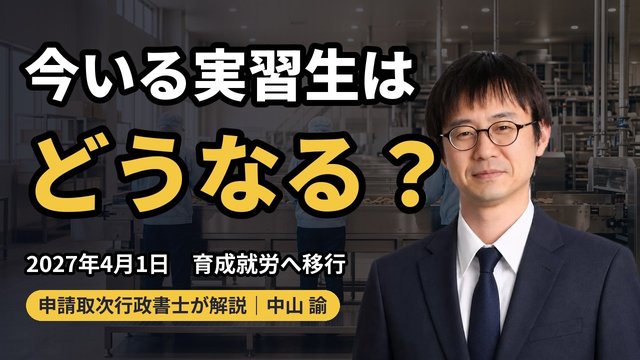
In the new sector-specific operational policy approved by the Cabinet on January 23, 2026 (Reiwa 8), the job categories and examinations for the food and beverage manufacturing sector will be reorganized as follows. The current categories and examinations will continue to be applied until March 31, 2027 (Reiwa 9) as a transitional measure.
| Until March 31, 2027 | From April 1, 2027 | |
|---|---|---|
| Job Category (i) & (ii) | General Food and Beverage Manufacturing | ① Food and Beverage Manufacturing (manufacturing and processing of food and beverages (excluding alcoholic beverages) and ensuring safety and hygiene) ② Fishery Processing (manufacturing and processing of fishery products and ensuring safety and hygiene) |
| Specified Skilled Worker (i) Skills Exam | Food and Beverage Manufacturing Specified Skilled Worker (i) Evaluation Exam | ① Food and Beverage Manufacturing Specified Skilled Worker (i) Evaluation Exam ② Fishery Processing Specified Skilled Worker (i) Evaluation Exam |
| Specified Skilled Worker (ii) Skills Exam | Food and Beverage Manufacturing Specified Skilled Worker (ii) Evaluation Exam | ① Food and Beverage Manufacturing Specified Skilled Worker (ii) Evaluation Exam ② Fishery Processing Specified Skilled Worker (ii) Evaluation Exam |
| Specified Skilled Worker (ii) Japanese Language | JLPT N3 or higher (B1 equivalent) | “Common European Framework of Reference for Languages” B1 equivalent or higher (details to be announced separately) |
The practical points are as follows:
The estimated number of Specified Skilled Worker (i) accepted in the food and beverage manufacturing sector is 133,500 people over five years from FY2024 to FY2028, and this will be operated as the acceptance cap. According to preliminary figures from the Immigration Services Agency (as of the end of June 2026), the number of residents is 100,769, with a fulfillment rate of 75.5%, and the increase over the past year is 16,698 people. By simple calculation, the remaining quota is approximately 32,700 people, and if the same rate of increase continues, the estimated number will be reached in about two years.
In the food service industry, which belongs to the same council, the issuance of Certificates of Eligibility was temporarily suspended from April 13, 2026, due to the fulfillment rate approaching the cap (for details, see Impact and Countermeasures for Suspension of Acceptance of Specified Skilled Worker in “Food Service Industry”). It has not yet been announced whether similar measures will be taken in the food and beverage manufacturing sector, but the sector-specific operational policy stipulates a mechanism for suspending issuance if “the estimated number of acceptances is expected to be exceeded.” The overall situation for all 19 sectors is summarized in Estimated Number of Specified Skilled Worker Acceptances | Food Service Industry 98% – Remaining Quota for 19 Sectors.
The estimated number of Specified Skilled Worker (i) accepted in the food and beverage manufacturing sector for the five years from FY2024 is 133,500 people, and this will be operated as the acceptance cap for the five years until the end of FY2028.
Sector-specific operational policy, Appendix 15 (Cabinet Decision on January 23, Reiwa 8), Part 1, 2 (4) I
Q1. Can I hire a Specified Skilled Worker to work in the deli section of a supermarket?
A. If the business establishment is a general supermarket or food supermarket that manufactures food products, you can have them engage in manufacturing tasks such as deli production or bakery production. However, they cannot engage in sales tasks such as cashiering or stocking shelves, even as related tasks, and a pledge to that effect must be submitted when joining the council.
Q2. Can I have them only sort and pack products?
A. No. Simple sorting and packaging (packing) alone do not constitute “manufacturing or processing,” and engaging solely in related tasks is not permitted. The premise is that they primarily engage in manufacturing and processing steps.
Q3. Can I entrust support to a Registered Support Organization that is not a member of the council?
A. No. A Registered Support Organization entrusted with implementing the Specified Skilled Worker (i) support plan must also be a member of the council and an organization that cooperates with the Ministry of Agriculture, Forestry and Fisheries and the council. When choosing an entrusted organization, please confirm whether they have a membership certificate.
Q4. Can I have a Specified Skilled Worker in the agriculture sector help out at my company’s processing plant only during busy seasons?
A. The Status of Residence “Specified Skilled Worker” is granted by specifying the sector and job category, so in principle, a person permitted in the agriculture sector cannot engage in tasks in the food and beverage manufacturing sector. Whether the processing of agricultural products falls within the scope of related tasks in the agriculture sector is subject to individual judgment, so please consult us in advance.
Q5. If I pass the current Specified Skilled Worker (i) skills test this year, what will happen after April 2027?
A. Those who pass the current test by March 31, 2027, will be deemed to have passed both the Specified Skilled Worker (i) skills tests for the new categories of “Food and Beverage Manufacturing” and “Fisheries Processing.” There is no need to retake the exam.
Of the 3,012 Specified Skilled Worker (i) in Miyazaki Prefecture, 707 (23.5%) are in the food and beverage manufacturing industry, making it the second largest sector after agriculture, with over 40% concentrated in Miyakonojo City. Accepting business establishments are limited to those primarily falling under one of the 10 classifications of the Japan Standard Industrial Classification, and workers cannot engage in tasks such as simple sorting and packaging or sales at supermarkets. Foreign nationals themselves are required to pass the Specified Skilled Worker (i) skills test and a Japanese language test (exempt for those who have completed Technical Intern Training (ii) in the target occupation). Companies are required to join the Food Industry Specified Skills Council (2-3 months for review, before Status of Residence application), issue a career advancement plan document, provide proof of practical experience, and ensure direct employment. From April 1, 2027, job categories will be divided into “Food and Beverage Manufacturing” and “Fisheries Processing,” and when hiring for fisheries processing, a careful explanation of the career path will be necessary. The national quota has reached a fulfillment rate of 75.5%, and multi-year hiring plans must incorporate trends in the quota.
Our office, based in Miyazaki City, assists food manufacturing, fisheries processing, and supermarket businesses in Miyazaki Prefecture with Specified Skilled Worker acceptance (confirmation of target business establishments, council membership, Status of Residence application, support plan), as well as foreign nationals working in this sector with their Status of Residence procedures.
Our office provides consultations to both foreign nationals and accepting companies, based on the latest institutional trends.
Please feel free to use our free consultation service first.
📩 Contact us here
📞 To book a phone consultation: 0985-68-0851
Before you submit, let us take a look.
Free Immigration Pre-Submission Check ›
For those who will apply for a status of residence at the Immigration Services Bureau by themselves. Before you submit, we check your application form and supporting documents and tell you about any missing documents and points to watch. We accept checks online (Google Meet, about 20 minutes) or via LINE.
・Eligible: applications for a Certificate of Eligibility, change of status of residence and extension of period of stay (applications for permanent residence are accepted only from residents of Miyazaki Prefecture). Naturalization is not covered.
・Online (Google Meet): once per application. Replies via LINE: available for the same application until you submit it.
・Our guideline for replies via LINE is, in principle, within 2 business days (we are closed on Saturdays, Sundays and public holidays; replies may take longer when we are busy).
・Please send copies of your documents by LINE or email. For your residence card, send the front side only; please do not send the side showing your My Number.
・What we tell you is our office’s opinion. It does not guarantee approval; the outcome depends on the decision of the Immigration Services Bureau.
・We only point out missing documents and points to watch. We do not prepare or rewrite your application documents for you or draft text for them, and we do not tell you whether your application is likely to be approved (if you would like to engage us, we will introduce the Self-Prep Course, the Light Plan and the Standard Plan).
・If we find that a document contains information that is not true, or that the application is not your own (or a family member’s), we will decline the check.
This article was written based on publicly available information as of September 2026. The number of residents is a preliminary figure published by the Immigration Services Agency (as of the end of December 2025, fulfillment rate as of the end of June 2026). The requirements for the food and beverage manufacturing sector, test names, Japanese language proficiency levels, and council review periods may change in the future due to revisions of operational guidelines, public notices, and council operational status. For actual acceptance and applications, please refer to official information from the Immigration Services Agency and the Ministry of Agriculture, Forestry and Fisheries, or contact our office.
Author of this article: Administrative Scrivener Authorized to File Applications, Satoshi Nakayama
Representative, Administrative Scrivener Corporation Miyazaki International Legal Office
Location: Miyazaki City, Miyazaki Prefecture