Blog

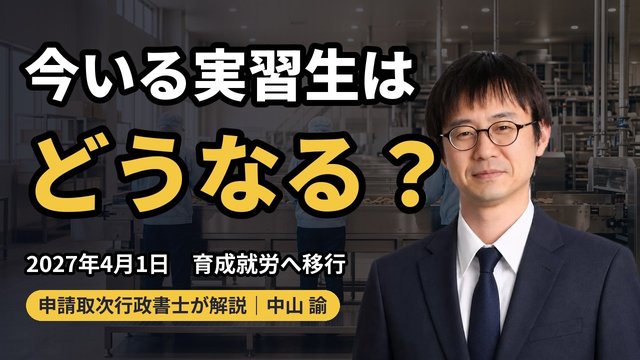
A new Status of Residence, “Employment for Skill Development (ESD; Japanese: Ikusei Shuro) Program,” which replaces the Technical Intern Training program, is scheduled to begin on April 1, 2027 (Reiwa 9). This marks a significant shift from the Technical Intern Training program, which advocated “international contribution through skill transfer,” to a system that explicitly aims for “securing and developing human resources.” For foreign nationals, a major change is that transfers based on the individual’s intent will be permitted under certain conditions. For accepting companies, significant changes include the reorganization of Supervising Organizations into Supervising Support Organizations and the need to review their acceptance systems. In this article, an Administrative Scrivener will clearly organize the overall picture of the ESD program, its differences from Technical Intern Training, requirements such as target fields, Japanese language proficiency, and Period of Stay, the transition to Specified Skilled Worker (i), and preparations to make now before its enforcement.
The Employment for Skill Development (ESD) Program was established by the “Act Partially Amending the Immigration Control and Refugee Recognition Act and the Technical Intern Training Act,” promulgated on June 21, 2024 (Reiwa 6), and is scheduled to commence operation on April 1, 2027 (Reiwa 9). The Technical Intern Training program will be progressively abolished in conjunction with this enforcement and transition to the ESD program.
The purpose of the program is to secure and develop foreign human resources in fields facing labor shortages. For a long time, a gap has been pointed out between the stated objective of Technical Intern Training, “international contribution through skill transfer,” and the reality of accepting individuals as a labor force. The ESD program’s essential significance lies in redefining this objective clearly as “securing and developing human resources.”
📌 Key Point: Employment for Skill Development (ESD) Program is an “entry Status of Residence,” leading to a path for long-term employment and settlement as Specified Skilled Worker (i) and (ii). It is not an end after 3 years but designed as a starting point for a career.
The Technical Intern Training program has faced the following challenges:
In response to these challenges, the Employment for Skill Development (ESD) Program implements revisions such as permitting transfers based on the individual’s intent under certain conditions, reorganizing Supervising Organizations into Supervising Support Organizations under a licensing system to strengthen their neutrality and functions, and incorporating the phased acquisition of Japanese language proficiency into the program. The aim is to protect workers’ rights while smoothly connecting them to Specified Skilled Worker status.
The main differences between Technical Intern Training and Employment for Skill Development (ESD) Program are summarized as follows:
| Item | Technical Intern Training (Current) | Employment for Skill Development (ESD) Program (Scheduled from April 2027) |
|---|---|---|
| Program Objective | International contribution through skill transfer | Securing and developing human resources |
| Period of Stay | Maximum 5 years (Category 1 to 3) | Generally 3 years |
| Transfer (change of workplace) | Generally not permitted | Transfer based on the individual’s intent permitted under certain conditions (Transfers due to unavoidable circumstances also remain permitted) |
| Provider of Supervision and Support | Supervising Organization | Supervising Support Organization (Strengthened functions under a licensing system) |
| Implementing Organization | Organization for Technical Intern Training (OTIT) | Foreign National Employment for Skill Development (ESD) Organization (Reorganization of the Organization for Technical Intern Training) |
| Japanese Language Requirements | Limited mandatory requirements under the program | Phased requirements at the start of employment and upon transition to Specified Skilled Worker |
| Future Path | Unclear connection to Specified Skilled Worker | Designed with the premise of transitioning to Specified Skilled Worker (i) and (ii) |
The most notable change is transfers. While Technical Intern Training generally did not allow changing workplaces, Employment for Skill Development (ESD) Program organizes it as follows:

For ESD, phased Japanese language proficiency is required as follows:
| Situation | Required Japanese Language Standard |
|---|---|
| Before Starting Work | Pass an exam equivalent to Japanese Language Proficiency A1 or higher (e.g., Japanese Language Proficiency Test N5), or complete at least 100 hours of A1-equivalent training in the “Employment” course at a certified Japanese language education institution. |
| When Transitioning to Specified Skilled Worker (i) | Pass an exam equivalent to Japanese Language Proficiency A2 or higher (e.g., N4) + Pass a skills test equivalent to Skill Test Grade 3 or higher. |
The system is designed to require a certain level of Japanese language proficiency from the start of employment and to further enhance it throughout the training period.
💡 Transfers are not “unconditional and at any time.” It is a framework that allows movement within the same field after a certain period of employment and meeting specific standards for skills and Japanese language proficiency.
📋 The key points for foreign nationals coming to Japan under ESD (or transitioning from Technical Intern Training) are as follows:
🏢 Accepting companies (including Supervising Organizations and Registered Support Organizations) will need to review their operational structures.
📅 Checklist for Companies Before Enforcement

The Technical Intern Training system is scheduled to be progressively phased out with the enforcement of the Employment for Skill Development (ESD) Program (scheduled for April 1, 2027). Transitional measures are being arranged for those who are undergoing Technical Intern Training at the time of enforcement.
Generally, it is 3 years. After that, if the requirements are met, one can transition to Specified Skilled Worker (i) (total of 5 years), and if one progresses to Specified Skilled Worker (ii), there will be no limit to the extension of the Period of Stay.
While ‘transfer based on one’s own intention’ is permitted, it is not unconditional. It is generally required to work at the same institution for a period exceeding the transfer restriction period (set between 1 and 2 years depending on the field), acquire the Basic Level of Skills Proficiency Test and Japanese language proficiency equivalent to A1 (N5, etc.), and then transfer within the same job category.
N5 equivalent (or completion of equivalent training) by the start of employment, and N4 equivalent is the guideline when transitioning to Specified Skilled Worker (i). The design is to gradually raise the level.
ESD covers 17 fields, which are structured by excluding ‘aviation’ and ‘automobile transportation’ from the 19 fields of Specified Skilled Worker. Three new fields, ‘linen supply,’ ‘logistics warehousing,’ and ‘resource recycling,’ will be added to the Specified Skilled Worker side.
We recommend confirming the acceptance fields, preparing for the transition to a supervising and support organization if you are a supervising organization, checking the transitional measures for Technical Intern Trainees, establishing a Japanese language and training system, and reviewing retention measures based on the premise of transfers, starting at an early stage before the enforcement.
The Employment for Skill Development (ESD) Program is a new system that replaces Technical Intern Training with the objective of ‘securing and developing human resources,’ and incorporates transfers based on one’s own intention and gradual Japanese language acquisition. Towards its enforcement in April 2027, the development of operational policies by field, ministerial ordinances, and guidelines is underway. While it expands transfer and career options for foreign nationals themselves, it challenges accepting businesses to transform into ‘chosen workplaces’ and establish appropriate systems. As the details of the system will be further clarified in the future, it is important to start preparations early while checking primary information.
Our office, based on the latest system trends, accepts consultations from both foreign nationals and accepting businesses.
Please feel free to use our free consultation service first.
Before you submit, let us take a look.
Free Immigration Pre-Submission Check ›
For those who will apply for a status of residence at the Immigration Services Bureau by themselves. Before you submit, we check your application form and supporting documents and tell you about any missing documents and points to watch. We accept checks online (Google Meet, about 20 minutes) or via LINE.
・Eligible: applications for a Certificate of Eligibility, change of status of residence and extension of period of stay (applications for permanent residence are accepted only from residents of Miyazaki Prefecture). Naturalization is not covered.
・Online (Google Meet): once per application. Replies via LINE: available for the same application until you submit it.
・Our guideline for replies via LINE is, in principle, within 2 business days (we are closed on Saturdays, Sundays and public holidays; replies may take longer when we are busy).
・Please send copies of your documents by LINE or email. For your residence card, send the front side only; please do not send the side showing your My Number.
・What we tell you is our office’s opinion. It does not guarantee approval; the outcome depends on the decision of the Immigration Services Bureau.
・We only point out missing documents and points to watch. We do not prepare or rewrite your application documents for you or draft text for them, and we do not tell you whether your application is likely to be approved (if you would like to engage us, we will introduce the Self-Prep Course, the Light Plan and the Standard Plan).
・If we find that a document contains information that is not true, or that the application is not your own (or a family member’s), we will decline the check.
This article is written based on publicly available information as of July 2026. Details of the system and its enforcement date may change in the future. For actual applications, please refer to the official information from the Immigration Services Agency or contact our office.
Author of this article: Administrative Scrivener Satoshi Nakayama
Representative, Administrative Scrivener Corporation Miyazaki International Legal Office
Location: Miyazaki City, Miyazaki Prefecture